How to prepare ahead of application season - tips and actions
15 Apr 2026, 12:28
While there’s still some time until the application season comes around, it’s never too early to start preparing. We spoke to our early career experts and asked them for their top tips to enter the application season with confidence and make the most out of it. Here’s what they had to say:



1. Prepare early and prepare strategically


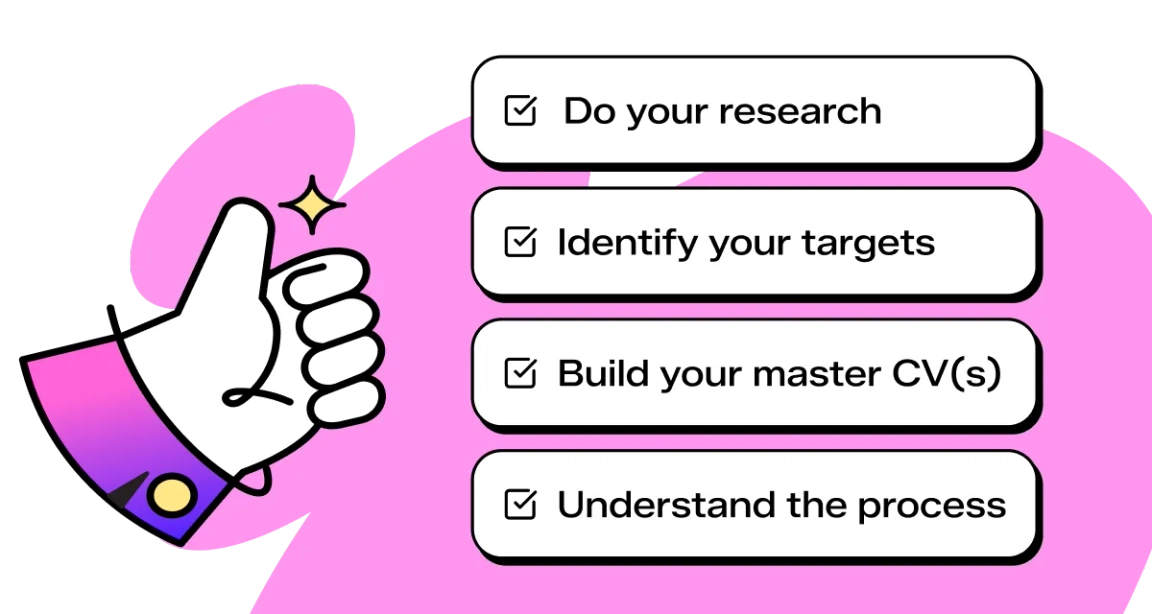
We can promise you - you will have enough on your plate come September, and there’s a lot to do before you can start sending out applications. Applying randomly, without a plan, will put you at a severe disadvantage compared to other applicants, who have started to prepare months in advance. Here’s a plan that will help you put yourself in the best position for application season and take advantage of all the free targetjobs tools built precisely to help you along the way:
Do your research:
What do you want to do? How do you get there? For example - let’s say you want to be an engineer. What engineering branches are you interested in? What companies operating in those fields offer graduate schemes? For years the common advice was: look for the graduate scheme postings from previous years - what were their requirements? If they posted the same job today, would you be a good match? Are you missing any of their requirements? Is there anything you can do now to be a better candidate in August?
The good news is that our career inspiration tool does the heavy lifting for you.



Simply answer a couple of questions, and find out:
- What fields you might want to consider based on your strengths and interests (you might be surprised!)
- What employers in those fields have historically expected from their applicants
- What you can work on now to improve your chances when the application season comes around.
Everything tailored to your circumstances. Speaking of tailoring…
Prepare your master CV(s):
While you should be tailoring your CV to each opportunity you apply to (more on this later), it doesn’t mean you need to start from scratch each time. At this point you should have seen a fair share of graduate scheme postings as part of your research by now, and you probably noticed that many of the requirements remain the same across different postings/employers. Here’s where having a master CV for each of the sectors you’re interested in is going to save you a lot of time. To stick to the engineering example, let’s say you’ll be applying to graduate schemes in mechanical and automotive engineering. Prepare one generic CV for mechanical engineering roles, and one for automotive engineering. Then make sure they’re the best they can be with our CV review tool.


These will serve as your templates for when it’s time to apply. You can do the same with cover letters, though keep in mind that these should be much more personalised, so you will have to tailor them heavily for every role.
Learn about the application process
CV and cover letters are only the first step in the application process. If you are shortlisted, it’s likely you will be asked to complete a psychometric test (almost always held online). It’s how employers roughly assess if you’re a good fit for the role and the company - there are no right and wrong answers, so you can never be 100% prepared - that’s the point of psychometric tests! That said, you should be familiar with what structure they can take and the type of tasks you are likely to be given - our guide to psychometric tests is a good starting point.
Beyond the psychometric tests, you will certainly take part in a number of interviews (online and in person), as well as assessment centres.
The best way to get good at interviews is always going to be attending real interviews, but you can simulate the experience ahead of time to know what to expect. See if your university’s career services offer mock interviews, or ask family or friends to help you practice. Lastly, definitely take advantage of our interview coach to get a feel for the type of questions you’re likely to be asked and receive personalised feedback.


Good news! Assessment centres are typically the last step in the application process. Slightly worse news - they’re the trickiest to prepare for. They come in all shapes and sizes - virtual, in-person, group exercises, presentation exercises, numerical reasoning tests - the list goes on. You’re going to want to narrow your research down to the fields and employers you identified earlier (hopefully with the help of our career inspiration tool 😉). That’s why we wrote bespoke advice pieces on sector-specific assessment centres (e.g. engineering assessment centres).
2. Get organised

.webp)
When the application season comes around, the last thing you want to do is keep track of everything in your head - that’s a recipe for forgetting deadlines, sending the wrong CV - you get the point. Now is the time to create processes that will save you time later.
Prepare a list of companies whose graduate schemes you’re interested in. Once they start receiving applications, make sure you have a method of tracking which ones you applied to, what deadlines you need to pay attention to, etc.
This could be on targetjobs (your dashboard has all of the information you need on the jobs you shortlisted and applied to), in an Excel spreadsheet - or even on paper! What matters is that you have a list you can reference, instead of trying to track everything in your head. Now is the time to think about your approach, so that you know what to do in September.
3. Get consistent


We’re not going to lie - graduate schemes are competitive. Very competitive. What that means, is that as much as we’d love to see you submit an amazing CV, get full marks on all assessments, dazzle the interviewers and receive the offer from the first employer you apply to, a more realistic expectation is that you’re going to spend a fair share of your time applying, and it’s easy to get discouraged when things don’t go your way at first.
Now is the time to create a plan you’re going to stick to during application season - no matter what. Set a realistic goal (e.g. apply to no fewer than 5 graduate schemes every week). Write it down, print and sign it, hang it on your wall - whatever will help you hold yourself accountable in autumn.
Don’t wait for September to come around - follow these steps and start laying down groundwork for success today.
targetjobs Editorial advice
This describes editorially independent and impartial content, which has been written and edited by the targetjobs content team. Any external contributors featuring in the article are in line with our non-advertorial policy, by which we mean that we do not promote one organisation over another.
